

How to Brew Better Coffee at Home: 2026 Guide
Table of Contents
- Why Most Home Brews Fall Short (And How to Fix It)
- The Coffee to Water Ratio Guide for Consistent Flavor
- Finding the Best Coffee Grind Size for Brewing
- Water Temperature and Quality: The Hidden Variables
- Step-by-Step: Brewing a Better Cup with Pour-Over
- How to Store Coffee Beans for Freshness
- Troubleshooting Bitter vs. Sour Coffee
- Budget-Friendly Home Setups That Work
- Frequently Asked Questions
Last Updated: September 23, 2026
Why Most Home Brews Fall Short (And How to Fix It)
Most home coffee tastes flat because of three fixable variables: an inconsistent grind, water that's too cool, and a ratio guessed by eye. Fix those, and you're most of the way to a genuinely better coffee at home. The good news is that learning how to brew better coffee at home costs almost nothing. Below, we'll show you exactly how to dial in each variable, plus the two mistakes that ruin more cups than cheap gear ever will.
The Coffee to Water Ratio Guide for Consistent Flavor
The starting point for any coffee to water ratio guide is simple: begin at 1:16, one gram of coffee to sixteen grams of water. That lands in the balanced range for most beans and brewers. Stronger? Move to 1:15. Lighter and brighter? Try 1:17.
Using a Scale for Precision
A digital scale removes guesswork entirely. Weigh your dose, then weigh your water as you pour. If your coffee tastes thin one day and muddy the next, the scale usually explains why. For a single 12-ounce mug, that's roughly 22 grams of coffee and 350 grams of water at 1:16.
Finding the Best Coffee Grind Size for Brewing
The best coffee grind size for brewing depends on your method, not your preference. Grind too coarse and water rushes past the grounds, leaving sour, weak coffee. Grind too fine and you get bitter, over-extracted cups. Match grind to brewer:
- Pour-over: medium-fine, like table salt
- Drip machine: medium, like sand
- French press: coarse, like breadcrumbs
- AeroPress: medium-fine to fine
Why a Burr Grinder Matters
A burr grinder crushes beans to a uniform size; a blade grinder chops them unevenly. If you're serious about how to brew better coffee at home, this is the single upgrade worth making first. Hand burr grinders cost far less than electric models and grind just as evenly, which makes them a strong entry point.
Water Temperature and Quality: The Hidden Variables
Water is roughly 98% of your cup, yet it's the variable most home brewers never check. Two things matter: how hot it is, and what's dissolved in it.
Temperature: The 195°F to 205°F Window
The target range is 195°F to 205°F. Water off a rolling boil is too hot and scorches the grounds; water that's cooled too long under-extracts and tastes sour. If you don't own a thermometer, boil, then wait about 30 seconds before pouring. For light roasts, aim toward the top of the range (around 205°F) to pull out the sugars that resist dissolving at lower temperatures.
The Chemistry Most Guides Skip: Minerals and Alkalinity
Here's the angle almost every ranking guide misses. "Filtered water" is not one thing. Water composition determines how efficiently flavor compounds leave the grounds, and the two levers are mineral content and alkalinity.
- Magnesium and calcium act as flavor carriers. They bind to the acids and sugars in coffee and pull them into solution. Water with too few of these minerals, distilled water, reverse-osmosis water, or heavily softened water, brews flat, lifeless coffee no matter how good your beans are.
- Alkalinity (bicarbonate) is the buffer that neutralizes coffee's natural acids. Too much alkalinity and your bright, fruity notes get muted into a dull, chalky cup. Too little and the cup can taste sharp and thin.
Three Practical Water Options
- Filtered tap water. A carbon filter (pitcher or faucet-mounted) removes chlorine and odors while leaving helpful minerals intact. This is the best default for most homes. If your tap water tastes good cold, it will usually brew well.
- Bottled spring water. Look for a brand with a mineral content listed on the label. Spring water generally lands in a workable range, and it's a simple fix if your tap water is very hard or very soft.
- Remineralized water. If you already use reverse osmosis or distilled water, add a brewing mineral packet or a pinch of Epsom salt and baking soda to restore the magnesium and buffer the water needs. This is the enthusiast route, but it's cheap and repeatable once you dial it in.
Get the water right and every other variable in this guide gets easier to dial in.
Step-by-Step: Brewing a Better Cup with Pour-Over
Pour-over gives you the most control of any manual method, and it takes about four minutes once you've practiced. Here's the process:
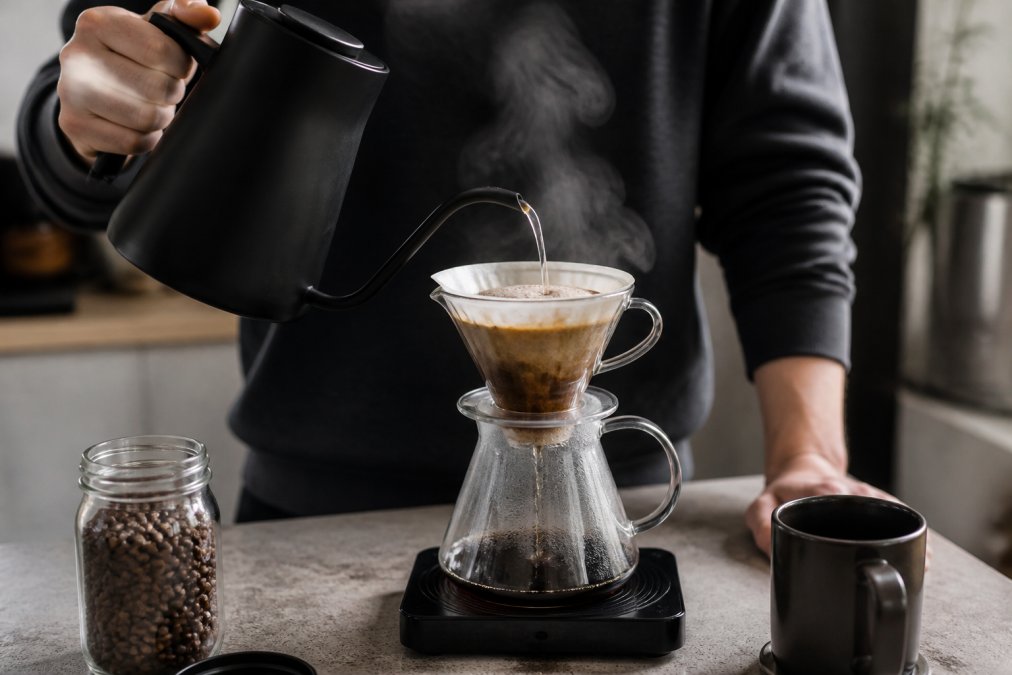
- Heat water to 200°F and rinse your paper filter with hot water
- Weigh 22 grams of coffee, ground medium-fine
- Start your timer and pour 60 grams of water to saturate the grounds
- Wait 30 to 45 seconds for the bloom, when the coffee degasses and bubbles
- Pour in slow circles to 350 grams total, finishing by 2:30
- Let it drain fully; total brew time should land near 3:00
How to Store Coffee Beans for Freshness
Learning how to store coffee beans for freshness comes down to four enemies: air, light, heat, and moisture. Keep beans in an opaque, airtight container at room temperature, away from the stove and the windowsill. Skip the fridge; it exposes beans to moisture and odors every time you open the door.
Troubleshooting Bitter vs. Sour Coffee
Bitter and sour coffee are opposite failures, and telling them apart is the fastest diagnostic skill you can build. Bitter means over-extraction: your grind is too fine, your water too hot, or your brew time too long. Sour or sharp means under-extraction: grind too coarse, water too cool, or the pour finished too fast.
| Taste Problem | Likely Cause | Fix |
|---|---|---|
| Bitter, harsh, drying | Over-extraction | Grind coarser or lower water temp |
| Sour, weak, salty | Under-extraction | Grind finer or raise water temp |
| Flat, lifeless | Stale beans or soft water | Check roast date; use filtered water |
| Inconsistent cup to cup | Uneven grind | Switch to a burr grinder |
Budget-Friendly Home Setups That Work
You don't need a café-grade setup to brew excellent coffee. In fact, the biggest gains come from two inexpensive tools, and everything else is optional. Here's a tiered path so you can spend where it actually moves the cup.
Tier 1: The Two Tools That Matter Most
If you buy nothing else, buy these:
- A hand burr grinder. This is the single highest-impact purchase. A burr grinder crushes beans to a uniform size; a blade grinder chops them unevenly, so some grounds under-extract while others over-extract. Hand burr grinders cost far less than electric models and grind just as evenly, which makes them the strongest entry point for anyone serious about how to brew better coffee at home.
- A digital scale. Ratio only works if you weigh it. A tablespoon of coarse grounds and a tablespoon of fine grounds differ by several grams, which is why scoop-based recipes taste different every morning. A basic kitchen scale that reads to one gram is enough.
With just these two, plus whatever brewer you already own, you can control grind and ratio, the two variables responsible for most bad cups.
Tier 2: The Next Upgrades, In Order
Once Tier 1 is in place, add these as budget allows:
- A basic dripper. A cone-shaped pour-over dripper is inexpensive and gives you more control than a drip machine. Pair it with paper filters.
- A gooseneck kettle. A slow, controlled pour keeps water from digging craters in the coffee bed. An electric gooseneck with temperature control is convenient, but a stovetop gooseneck plus a thermometer works fine and costs less.
- A thermometer. If your kettle doesn't have one, a simple instant-read thermometer takes the guesswork out of the 195°F to 205°F window.
Tier 3: Nice-to-Have, Not Necessary
Electric burr grinders, programmable brewers, and precision kettles are genuinely good tools, but they refine a cup that's already good. They don't rescue a cup built on stale beans or an inconsistent grind. Buy them when the technique is solid, not before.
Where to Spend Instead: The Beans
The most underrated budget move is spending more on coffee, not gear. Freshly roasted beans from a roaster that ships to order will improve your cup more than any gadget. A bag that's days off the roast, rather than months, gives the technique you've built something worth brewing. First and Ten Coffee offers a range of roasts and blends, roasted for maximum flavor and aroma, with reliable delivery to your door and a simple ordering process.
Frequently Asked Questions
What is the most effective way to brew coffee at home?
The most effective method is one you can repeat consistently. Start with freshly roasted beans, grind them right before brewing, and use a scale to measure a 1:15 to 1:17 coffee-to-water ratio. Water should be between 195°F and 205°F. Pour-over and immersion brewing both deliver excellent results if you control grind size, water temperature, and brew time.
What is the 15-15-15 coffee rule?
The 15-15-15 rule is a simple memory aid: use a 1:15 coffee-to-water ratio, aim for a 15% extraction yield, and keep total brew time around 15 minutes for cold brew or 1.5 to 3 minutes for hot pour-over. It helps beginners remember that dose, extraction, and time all affect flavor. Adjust one variable at a time to taste.
How does water temperature affect coffee extraction?
Water temperature controls how quickly flavor compounds dissolve from coffee grounds. Water that is too hot (above 205°F) pulls out bitter, harsh compounds. Water that is too cool (below 195°F) leaves coffee sour and weak. The sweet spot is 195°F to 205°F, which extracts balanced acidity, body, and sweetness. Use a thermometer or a kettle with temperature control.
Why should you grind coffee beans right before brewing?
Coffee beans start losing aroma and flavor within minutes of grinding because the increased surface area exposes oils to oxygen. Grinding right before brewing preserves the volatile compounds that create a rich flavor profile. For the best results, invest in a burr grinder for consistent grind size, and only grind what you need for that cup.